PH: (02) 9890 1766
info@dhporter.com.auThe bearing at the after end of the stern tube carries the weight of the shaft and the propeller hanging off it, in seawater, with no grease and no attention for years at a time. DH Porter stock cutless and composite bearings in standard diameters from 3/4” through to 4”, and machine odd and metric sizes to order in our North Parramatta workshop.
Cutless is the original trade name and the one we use here. You will also see the same bearing written as a cutlass bearing, a stern tube bearing or a propeller shaft bearing.
A cutless bearing does not run metal on metal. A nitrile rubber liner is bonded inside a rigid shell, and the bore of that liner is grooved along its length. As the shaft turns it draws water through those grooves, and the shaft lifts onto a thin film of water rather than riding directly on the rubber.
Two useful things follow. The bearing cools itself, because the water carrying the load also carries away the heat. And it clears itself: the sand and grit that would otherwise embed in the liner and score the shaft get flushed out along the grooves.
Both depend on water actually moving through the bearing. A bearing starved of water will run hot, glaze and wear out quickly no matter what it is made of.
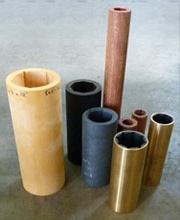
We hold two families of bearing, and they solve the problem in different ways.
Do not fit a brass-shelled bearing into a steel or aluminium stern tube. Brass and steel, and brass and aluminium, sit a long way apart on the galvanic scale, and in seawater the less noble metal is the one that corrodes. That is your stern tube, not the bearing. In a steel or aluminium tube, use a phenolic shell or a composite bearing, all of which are electrically inert and sidestep the problem entirely.
Three measurements identify a cutless bearing, and all three have to be right:
Imperial bearings step in 1/8” increments, metric bearings in 5mm. They are not interchangeable, and a metric bearing is not a rounded-off imperial one. If you are unsure which you have, measure the shaft rather than assume, or bring the old bearing in and we will match it.
A worn bearing usually announces itself before it does any harm:
Some play is normal in a new bearing, because the shaft is meant to sit on water rather than on rubber. It is a change from what the boat did before that matters.
Most bearings that fail early were not worn out, they were prevented from working:
If a bearing has worn unevenly or gone through more than one in quick succession, the bearing is the symptom. Shaft servicing and alignment is where that gets sorted.
Being a machine shop rather than only a supplier means we are not limited to what comes in a box. Metric and non-standard sizes are machined to order, worn or oversized housings can be bored and sleeved to take a standard bearing, and complete stern tubes and bearing housings can be made from scratch or matched to existing hardware. New shafting can be supplied cut, tapered and keyed to suit at the same time.
Ring the workshop on (02) 9890 1766 with your shaft diameter, housing bore and stern tube material, and we will tell you what is on the shelf and what needs to be made.